Ask people who grew up in Cyprus or Greece what they eat when they want to feel at home, and the answers are rarely restaurant dishes. Fasolada, the white bean soup. Trahanas in winter, with cubes of halloumi softening in the bowl. Avgolemono, chicken soup thickened with egg and lemon. Koupepia, vine leaves rolled around rice and minced meat. Spanakorizo with a piece of feta on the side.
These dishes are cooked at home, often on an ordinary weekday, and nobody calls them special. That is exactly why they matter. From 2024 to mid 2026 I was Executive Chef at SeaNatra in Larnaca, where the kitchen cooked modern Greek food: honest flavours, clean presentation and dishes made for sharing. Several of my own dishes start from home cooking like this. Here is how I bring a comfort dish to a tasting menu or a private dinner, and what I am careful never to lose.
What makes a dish comforting
Comfort food is not a style of cooking. It is a memory. A dish comforts because the person eating it has eaten it many times before, usually at a family table, usually cooked by someone they love.
From a cook’s point of view, the Greek and Cypriot comfort dishes have a few things in common:
- Softness. Vegetables cooked slowly in olive oil, rice cooked until tender, aubergine that gives way under a fork.
- Plenty of sauce. Tomato, olive oil, egg and lemon, béchamel: something to soak up with bread.
- A familiar seasoning. Lemon and dill in spinach rice, mint in the stuffing, a little cinnamon in the meat sauce of papoutsakia or moussaka.
- Generosity. One large dish in the middle of the table, and a second helping.
This is also where refining a dish can go wrong. Make it small, cold, precise and new, and you can remove exactly the things that made it comforting. The guest admires the plate but does not recognise it.
What I keep and what I change
My rule is simple: the guest should recognise the dish with the first bite, even if they did not recognise it when it arrived.
What I keep:
- the main ingredient, cooked properly and tasting of itself;
- the seasoning that identifies the dish, because that is what memory holds on to;
- the texture people remember, such as soft aubergine or tender rice.
What I change:
- the portion and the shape, so the dish works as one course among several;
- the balance, with a bright oil, fresh herbs or a little acidity to lift a heavy dish;
- the contrast, with a crumb, nuts or a crisp element against all that softness;
- the timing, so that parts usually cooked together in one pot can be cooked separately, each one at its best, and brought together on the plate.
Refining, for me, means taking things away and sharpening what is left. It does not mean hiding the dish under new ideas.
Three dishes from my kitchen
Cabbage Rolls. Stuffed cabbage leaves, lahanodolmades in Greek, are a winter dish, traditionally served in an egg and lemon sauce. My Cabbage Rolls are a starter: the rolls sit on a white sauce, with bright green oil, pine nuts and micro herbs. The roll stays a roll. The pine nuts add crunch, and the green oil adds colour to a dish that is usually soft and pale.
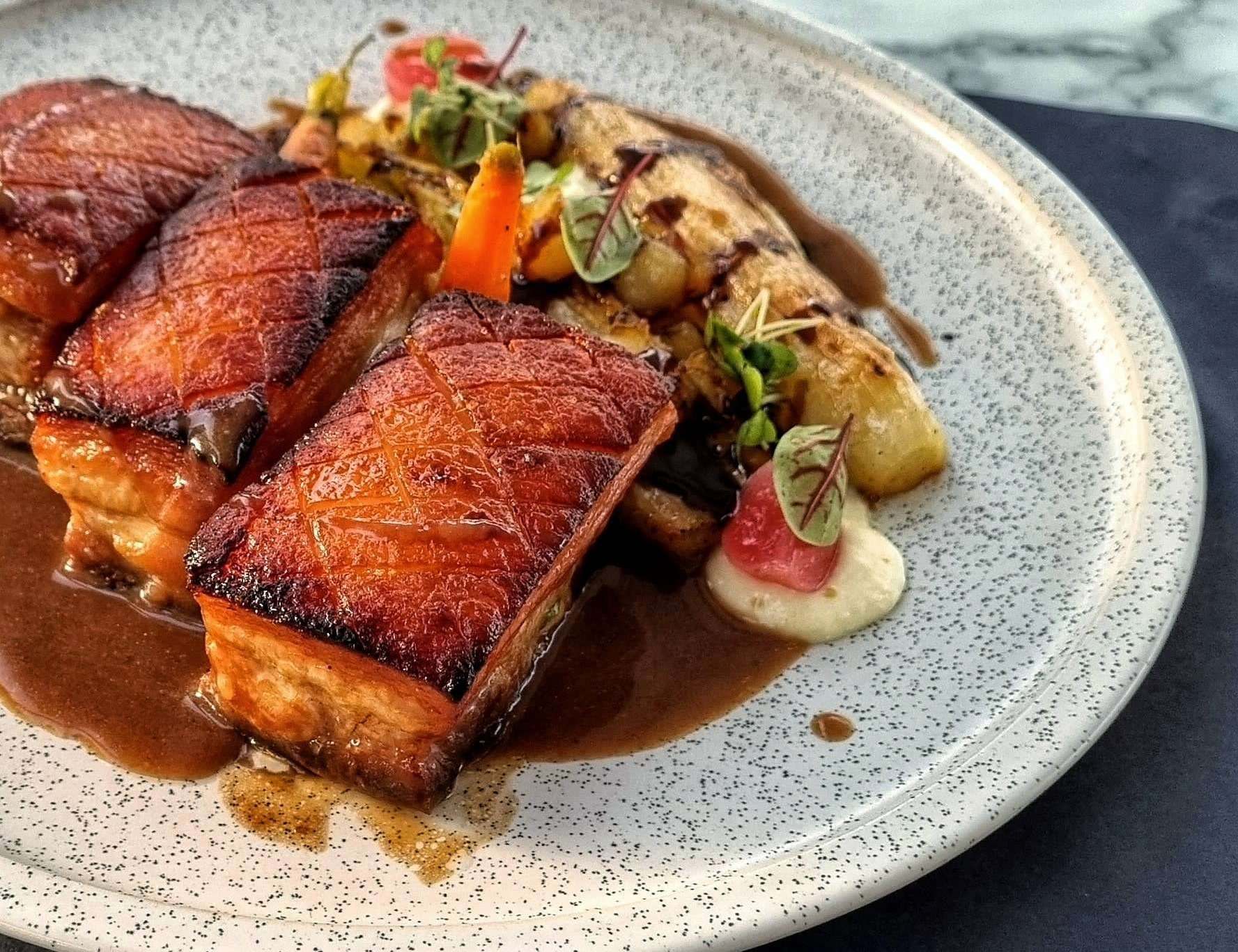
Papoutsaki. Papoutsakia, “little shoes”, are aubergine halves filled with minced meat in tomato sauce, covered with béchamel and baked. My Papoutsaki Aubergine is a main course built on the same vegetable. The aubergine keeps its thick white topping, as in the original. A crumb adds crunch, chives and micro herbs add freshness, and a sauce and a green oil go underneath. Whatever changes around it, the aubergine stays at the centre.
Calamari & Black Spanakorizo. Spanakorizo is spinach and rice cooked slowly in olive oil, usually with spring onions, dill and lemon. It is one of the humblest dishes in the Greek kitchen, and one of the most loved. In my Calamari & Black Spanakorizo, the spinach rice becomes the base of a main course: calamari on black spanakorizo, with dots of dark green purée, a crumb for crunch, curly kale and micro herbs. The rice is still the heart of the plate; the calamari makes it a dish for a special evening.
Comfort food at a private dinner
A tasting menu made entirely of new things can feel like a test. One course that everyone at the table knows from home puts people at ease.
Every menu I cook is written for the people at the table, so the dishes they grew up with are worth knowing about. If you are planning an evening, it helps to tell me:
- any dish your family always cooks, from Cyprus, Greece or anywhere else;
- who will be at the table, from grandparents to children;
- whether you want the dish to be recognisable at first sight, or a surprise that reveals itself in the first bite.
The rest of the menu can be as modern as you like. You can read how a private dinner works, from the first message to the clean kitchen at the end of the evening.